


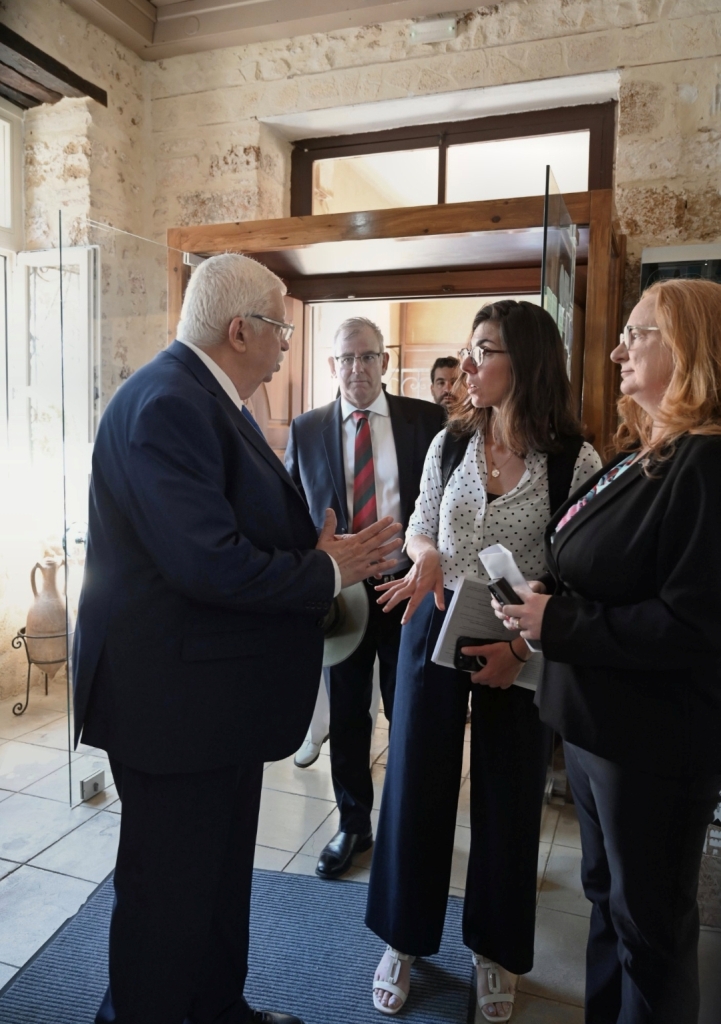
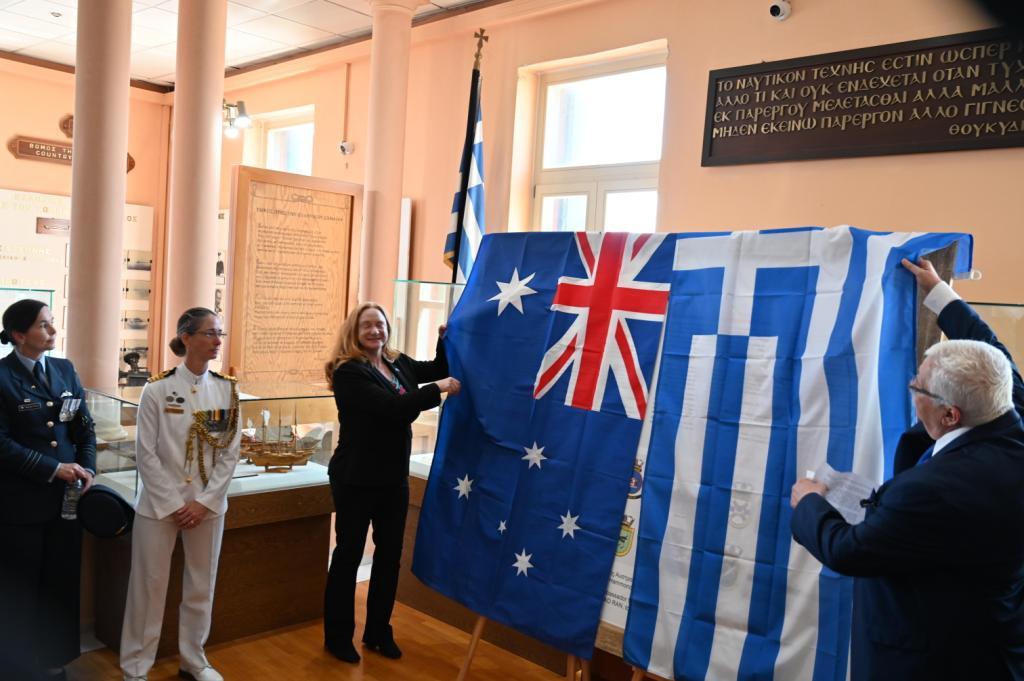
The Maritime Museum of Crete, bearing a profound sense of responsibility for preserving our history, actively participates each year in the commemorative events honouring the Battle of Crete, which take place during the final days of May. For 2026, the Museum’s commemorative ceremony was held on Friday, 22 May, at 11:00 a.m., following the Official Flag-Raising Ceremony and the playing of the national anthems of the Allied nations (Greece, the United Kingdom, Australia, and New Zealand).
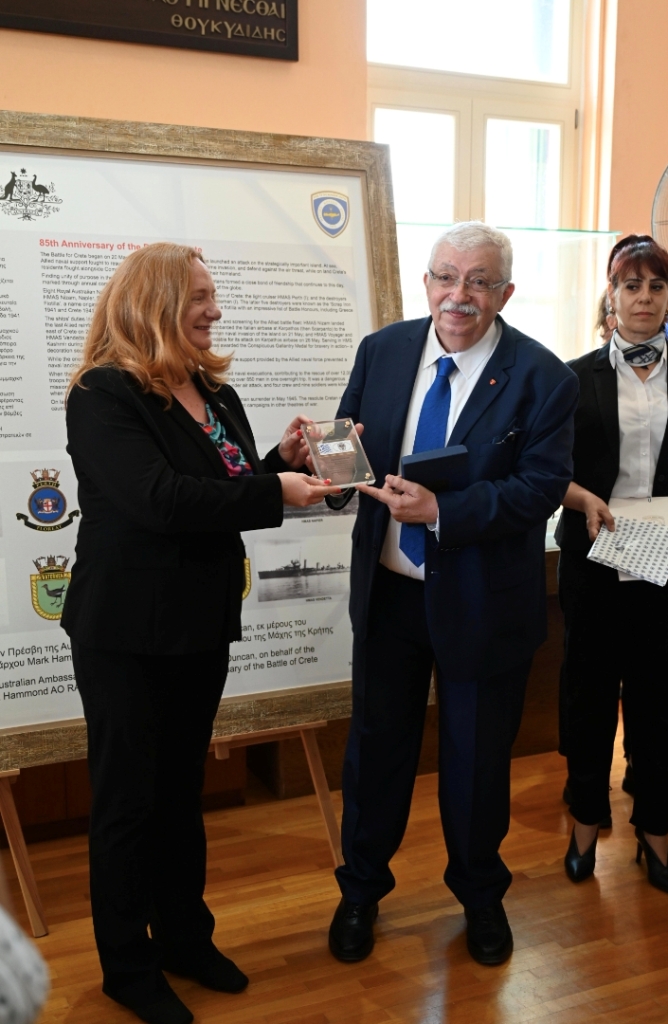
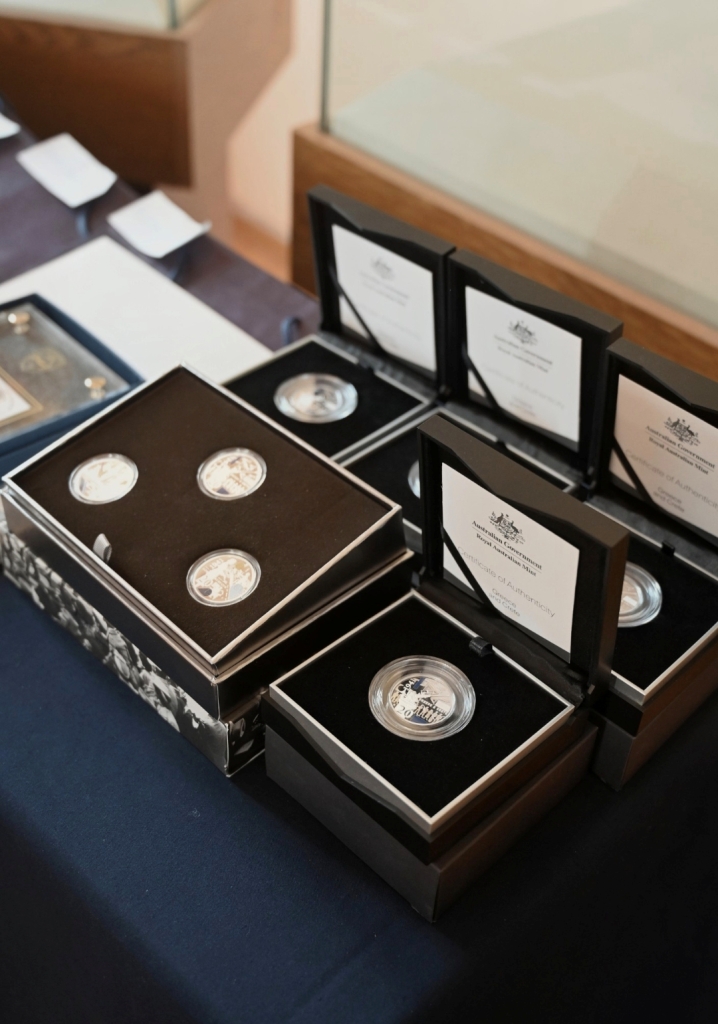
Following correspondence with the Australian Embassy and the esteemed Ambassador, Alison Duncan, a presentation was delivered on the Royal Australian Navy warships that participated in the military operations during the Battle of Crete. The event also featured the presentation of a generous donation of three commemorative silver coins issued by the Royal Australian Mint, commemorating the Australian campaigns in Greece and Crete, North Africa and the Middle East, and the contribution of Australian women during the Second World War.
The event also marked the opening of the philatelic exhibition “Crete 1940–46: The Difficult Years before the Outbreak of War”, curated by the distinguished philatelist and international exhibition judge George Thomareis. The exhibition featured a remarkable collection of philatelic material from the period of the Battle of Crete, including postage stamps, postcards, envelopes, and other related items.
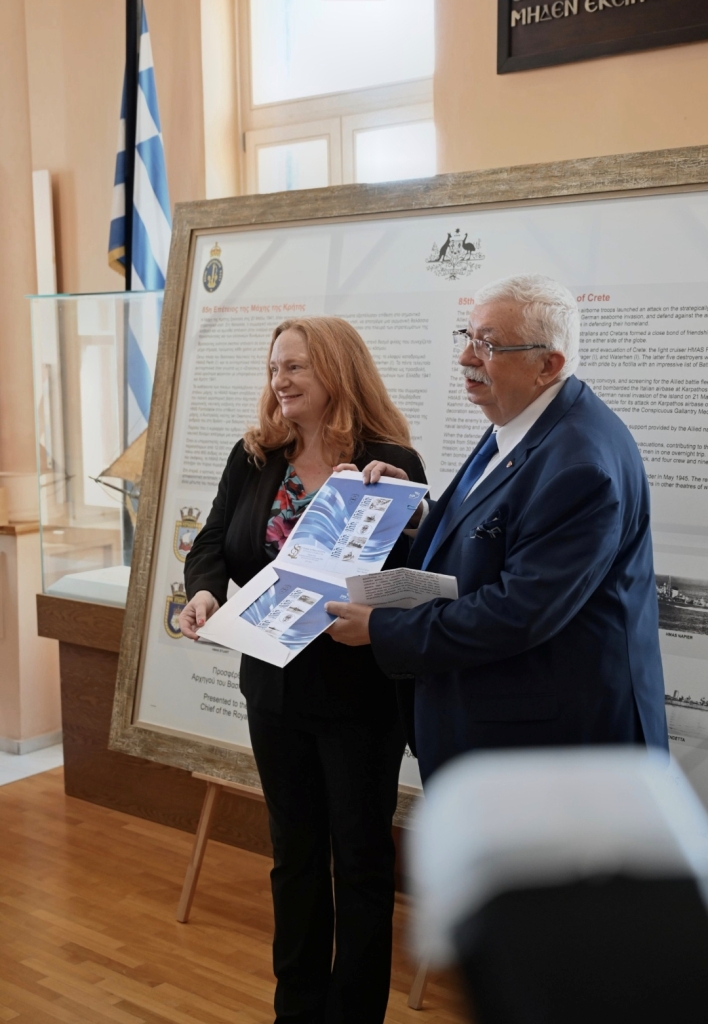
On behalf of the Maritime Museum of Crete, a personalised commemorative stamp sheet, produced in cooperation with the Hellenic Post, was also presented. Issued in a limited edition, the stamp sheet depicts the Australian warships that participated in the Battle of Crete.
At the conclusion of the ceremony, a customary exchange of commemorative gifts took place.
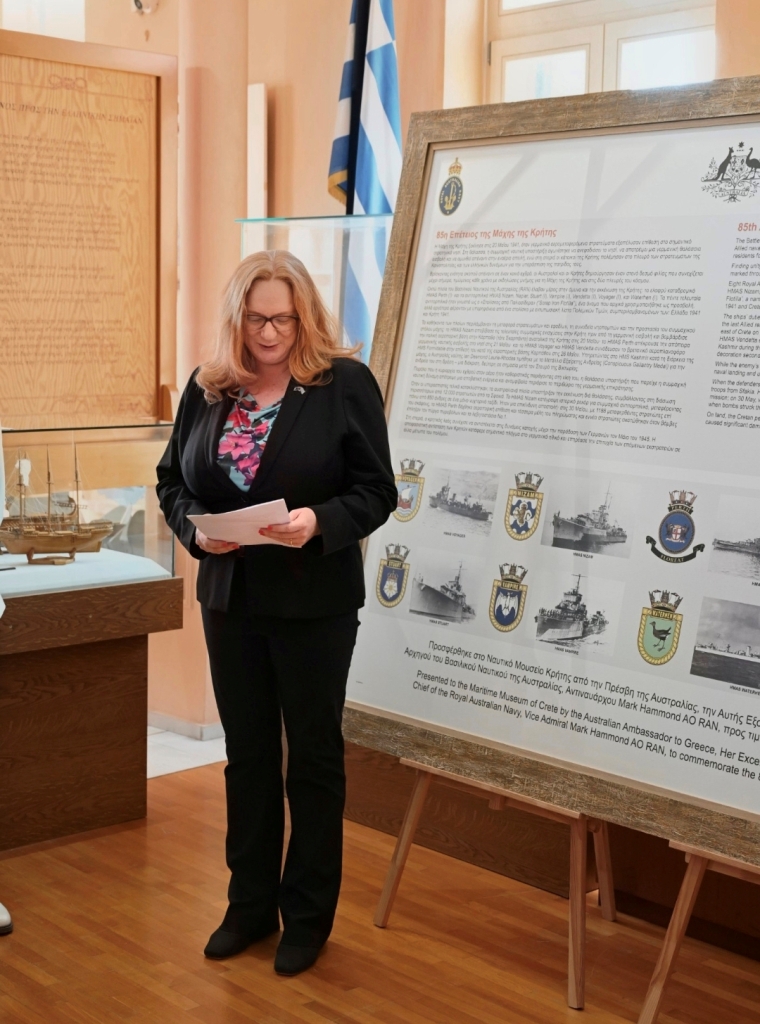
The Eight Royal Australian Navy Ships that Participated in the Naval Operations of the Battle of Crete
During the Battle of Crete (20 May – 1 June 1941), eight ships of the Royal Australian Navy (RAN) took part in Allied naval operations, contributing to the defence of the island, the transport of reinforcements, and the evacuation of Allied troops to Egypt. These vessels were HMAS Perth, HMAS Nizam, HMAS Napier, HMAS Stuart, HMAS Vampire, HMAS Vendetta, HMAS Voyager, and HMAS Waterhen.
HMAS Perth
The light cruiser HMAS Perth participated in Allied naval operations during the Second World War, particularly in the evacuation of British and Commonwealth forces from mainland Greece in 1941. During the Battle of Crete, on 21 May, it helped repel the German attempt to launch a seaborne invasion as part of Force C. On 28 May, Perth was assigned to Force D during the evacuation of Allied troops from the island. After embarking 1,188 soldiers at Sfakia, the cruiser came under continuous attack from German aircraft. During one of these attacks, its boiler room was damaged. After remaining immobilised for approximately thirty minutes, Perth resumed its voyage and successfully reached Alexandria. The cruiser was later lost during the Battle of the Sunda Strait in Indonesia in 1942. Several members of her crew received gallantry awards for their service during the Battle of Crete.
HMAS Nizam
Before the Battle of Crete commenced, the destroyer HMAS Nizam bombarded the Italian base on Karpathos on 20 May 1941. On 26 May, Nizam, accompanied by HMS Abdiel and HMS Hero, delivered reinforcements to Souda Bay. Two days later, together with HMAS Napier, HMS Kelvin, and HMS Kandahar, it transported supplies and ammunition to Sfakia. Later that day, more than 400 troops embarked on the Australian destroyers. As the campaign deteriorated, Nizam and Napier carried out two evacuation missions, transporting Allied troops from Crete to Alexandria. On 30 May, the two destroyers returned to Sfakia and embarked a total of 1,403 soldiers, with Nizam setting a record for a destroyer by carrying more than 850 men on a single overnight voyage. Despite suffering damage during German air attacks, the ship returned safely to Alexandria. Following repairs, Nizam continued to serve in Allied operations, including the Syrian Campaign and Operation Exporter against Vichy French forces. After the war, she served in reserve at Harwich and later Chatham before being decommissioned and scrapped in Essex in 1955.
HMAS Napier
In May 1941, HMAS Napier served with the Allied Mediterranean Fleet, primarily escorting convoys between Alexandria and Crete as part of Force A1. On 24 May, it joined a newly formed force tasked with attacking the airfield on Karpathos. Following the severe attack on the aircraft carrier HMS Formidable, Napier returned to Alexandria. On 28 May, it sailed again as part of Force C alongside Nizam, Kelvin, and Kandahar to assist in the evacuation from Sfakia, returning to Alexandria with 244 troops. On 31 May, during the final stages of the evacuation, Napier once more entered Sfakia and departed during the early hours of 1 June carrying 709 soldiers. After the war, the vessel returned to Royal Navy service and remained in reserve until its final disposal in 1956.
HMAS Stuart
HMAS Stuart was part of the famous “Scrap Iron Flotilla”, a group of Australian destroyers distinguished by an impressive wartime record. On 22 May, Stuart was tasked with securing the sea route between Alexandria and Crete in support of evacuation operations. The following day, together with HMAS Vendetta and HMAS Waterhen, it participated in the search for survivors from the cruiser HMS Fiji. On 25 May, alongside HMS Jaguar, Stuart escorted the transport ship Glenroy from Alexandria to Tymbaki, south of Crete, carrying reinforcements. Continuous enemy air attacks forced the abandonment of Glenroy, and the escorting force returned to Alexandria. On 30 May, Stuart joined the evacuation flotilla returning from Sfakia in order to provide additional protection. Having steamed approximately 250,000 miles on wartime service, Stuart was placed in reserve in Sydney in 1946 and sold for scrapping the following year.
HMAS Vampire
At the outbreak of the war, HMAS Vampire saw extensive service in the Mediterranean, supporting operations from Souda Bay. It participated in Operation Lustre, which transported Allied forces from Alexandria to Greece, and later in Operation Demon, which evacuated Allied troops from Greece to Crete. By mid-1941, continuous operational demands had exhausted the vessel, leading to its withdrawal from Mediterranean service and transfer to Singapore. Like Stuart, Vampire was also a member of the Scrap Iron Flotilla. In April 1942, while escorting the aircraft carrier HMS Hermes in the Indian Ocean, the destroyer came under intense attack by Japanese aircraft. Although it managed to shoot down one enemy aircraft, Vampire was ultimately sunk after suffering devastating bomb damage.
HMAS Vendetta
With Axis forces increasing their pressure throughout the Mediterranean, HMAS Vendetta was deployed to support Allied operations. On 11 May 1941, it sailed to Souda Bay carrying troops and supplies and returned to Alexandria on 16 May. Following the outbreak of the Battle of Crete, Vendetta conducted patrol duties with HMAS Voyager between 21 and 26 May. On 24 May, it joined the force assigned to attack Karpathos airfield. During this operation, on 26 May, Vendetta witnessed the severe air attack against HMS Formidable, approximately 150 miles south of the Kasos Strait. The following day, it escorted damaged Allied units while protecting HMS Abdiel, HMS Hero, and HMAS Nizam as they approached Souda Bay with reinforcements and supplies. A member of the Scrap Iron Flotilla, Vendetta accumulated an impressive wartime record before being decommissioned in 1945 and scrapped in Sydney in 1948.
HMAS Voyager
HMAS Voyager served extensively in the Mediterranean and actively participated in Operations Lustre and Demon. Following the Allied withdrawal from mainland Greece, Voyager moved south to support the defence of Crete and took part in operations around Souda Bay. It also participated in rescue efforts following the loss of HMS Fiji. By 23 May, the deteriorating military situation had become evident, and Voyager was ordered to withdraw after the losses of Gloucester, Juno, Greyhound, Kelly, and Kashmir. On 24 May, it joined the force assigned to attack Karpathos airfield and, two days later, witnessed the attack on HMS Formidable south of Kasos. Returning to Alexandria on 27 May, the destroyer subsequently reinforced operations connected with Tobruk. Like several of its sister ships, Voyager belonged to the Scrap Iron Flotilla. In June 1942, while operating in the Pacific, the destroyer ran aground and was lost at Betano Bay, Timor, where parts of the wreck remain visible today.
HMAS Waterhen
HMAS Waterhen served extensively in Mediterranean operations. On 16 May 1941, together with HMS Coventry, HMNZS Auckland, and HMAS Voyager, it transported approximately 700 troops of the Argyll and Sutherland Highlanders to Tymbaki in southern Crete to reinforce the island before the German invasion. On 18 May, it was assigned to support operations connected with Tobruk. Later, on 23 May, Waterhen joined Stuart and Vendetta in searching for survivors from the cruiser HMS Fiji. Like Stuart, Vampire, Vendetta, and Voyager, it was a member of the renowned Scrap Iron Flotilla. During operations associated with the defence of Tobruk in June 1941, Waterhen and HMAS Defender came under enemy air attack. Although not directly hit, Waterhen suffered severe structural damage that rendered it incapable of continuing operations. When it became clear that the ship could not be saved, the crew transferred to Defender and watched as Waterhen sank. It was the first ship of the Royal Australian Navy to be lost during the Second World War.
